
Last updated: 13.08.2026. Author: toprate.co.za
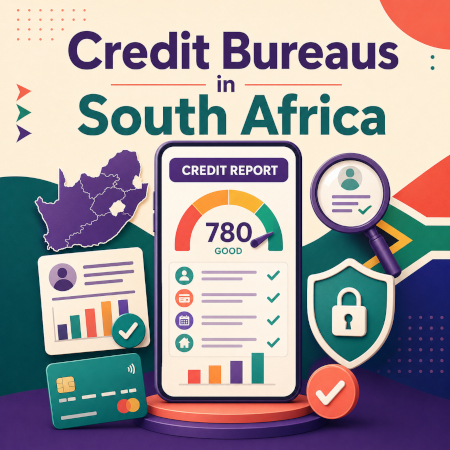 Table of Contents
Credit bureaus in South Africa collect information about credit accounts and repayment behaviour. Banks, retailers and other lenders use this data when considering a loan application, but the bureau does not approve or decline the loan.
Checking your own credit report can help you find incorrect information, unfamiliar accounts and repayment problems before applying for credit.
A credit bureau is a registered organisation that receives, stores and processes consumer credit information. This information is used to create credit reports, credit profiles and risk indicators.
Credit bureaus receive data from sources such as:
The National Credit Regulator (NCR) registers and monitors credit bureaus under the National Credit Act. The NCR’s current register includes both large consumer bureaus and specialist organisations providing identity, fraud, property, tenant or commercial-data services.
| Credit bureau | Consumer report access |
|---|---|
| TransUnion | Credit report and score through its consumer platform |
| Experian | Free report and score through Up powered by Experian |
| XDS | Free XDS report and score through Splendi |
| Consumer Profile Bureau | Free-report and dispute facilities through CPB |
A credit bureau does not:
The final decision belongs to the credit provider. A bureau supplies information that the lender may combine with the application form, income, expenses, affordability calculation and its own lending rules.
A credit report in South Africa normally contains identifying information and a record of how the consumer has used credit.
The precise layout differs between bureaus, and one report may contain an account that has not yet appeared on another. Credit providers submit updates according to their reporting processes, so it is useful to check reports from more than one bureau.
A report may include:
Incorrect personal details may be caused by an administrative mistake, outdated information or identity fraud.
A credit report should not use characteristics such as race, religion, political affiliation or medical history as consumer credit data.
The report can show credit agreements such as:
For each account, the report may show the lender, account status, credit limit, outstanding balance, instalment and opening date.
Closed or paid accounts do not necessarily disappear immediately. Historical payment information can remain available for a prescribed retention period and may show that an account was settled successfully.
Your credit history records whether instalments were made:
The payment profile can help lenders distinguish between a consumer who has used credit responsibly and one who is currently struggling with existing commitments.
Under the credit-information retention regulations, factual payment-profile information may be displayed and used for credit scoring or assessment for up to five years.
Reports may show that an account is one, two or more months in arrears.
A late payment does not always become a formal default immediately, but repeated arrears can lower a credit score and influence a lender’s assessment.
Credit providers may submit adverse information only after the required instalments have remained unpaid for at least three consecutive billing cycles and after giving the consumer the required notice.
A default is negative information submitted after the consumer fails to comply with a credit agreement.
Examples can include:
The exact retention period depends on how the information is classified and whether the debt has been paid. TransUnion currently explains that subjective default classifications may remain for one year, while some enforcement-related classifications may remain for two years. Paid defaults must be updated after the lender notifies the bureaus.
A judgment may appear when a court has ordered the consumer to pay a debt.
Under the regulations, civil judgments may remain for the earlier of:
Other public information, including sequestration, rehabilitation and administration orders, has its own retention rules.
A report may show that a consumer has applied for or entered debt review.
Debt review is not simply another negative score category. It is a formal process intended for consumers who are over-indebted. The indicator generally remains until the relevant requirements have been completed and a clearance certificate has been issued.
An enquiry is recorded when an authorised company accesses a credit profile.
Enquiries can arise from:
Credit enquiries may be displayed for one year under the prescribed retention periods.
The report normally shows that an enquiry was made, not whether the application was approved or declined.
A lender does not normally rely on one number or one negative account. It considers credit bureau data together with the information supplied during the application.
The lender may use the report to determine how the applicant has managed previous debts.
A history of regular, on-time payments can indicate lower repayment risk. Recent arrears, defaults or several unpaid accounts may indicate that another loan would be more difficult to manage.
Applicants must disclose their financial obligations accurately during an affordability assessment.
The lender must also take account of monthly debt repayments shown on a consumer profile held by a registered credit bureau. This helps identify debts that may have been omitted from the application or forgotten by the applicant.
Several recent enquiries or newly opened accounts can suggest that the applicant is seeking credit from multiple providers.
This does not automatically cause a decline, but the lender may investigate whether the consumer’s financial position has changed since the latest accounts were opened.
Some lenders use risk-based pricing. This means the rate offered can depend partly on the estimated likelihood of repayment.
An applicant with a stronger credit profile may qualify for a lower rate than a higher-risk applicant, although income, security, loan type and lender policy also affect pricing. The NCR has identified access to potentially lower interest rates as one benefit of a healthy credit profile.
After completing a credit check, the lender may:
The credit bureau does not make this decision. Each lender has its own approval and risk policies.
Credit bureau information may also help a lender identify:
A verification issue can lead to additional checks even when the applicant has a good repayment history.
A credit score in South Africa is a numerical summary based on information in a credit report. It is designed to indicate the level of risk associated with the consumer’s recent credit behaviour.
The calculation may consider factors such as:
A higher score usually represents a stronger bureau profile, but there is no single universal South African credit-score scale.
Different bureaus may:
For example, TransUnion and Experian both provide scores on scales extending to 999, but their score bands and models are not necessarily identical. A score from one service should therefore not be directly compared with a score from another bureau as though they were the same product.
A lender may create its own internal risk score using:
The score displayed in a consumer app is therefore a useful guide, not a promise of approval.
One lender may accept an applicant whom another lender declines. The result can depend on:
A high score does not overcome an unaffordable repayment, and a low score does not always produce an automatic decline.
It may be possible to obtain a loan with bad credit, but the available amount, rate and repayment term may be less favourable.
A lender may look beyond an old missed payment when the applicant now has:
However, poor credit does not create a right to approval. The lender must still complete an affordability assessment and consider existing monthly debt obligations and repayment history.
Review possible loans for bad credit while comparing the full repayment amount rather than only the monthly instalment.
Avoid providers promising:
A legitimate lender cannot guarantee the outcome before reviewing the application.
Consumers should check their reports before applying for a large loan, after settling problem accounts and whenever they suspect identity fraud.
The NCR maintains the official register of authorised credit bureaus. The list changes as new organisations are registered or existing registrations are cancelled or allowed to lapse.
Consumer-facing credit report options commonly referenced by the NCR include:
The NCR has directed consumers to these bureaus when requesting reports, while the current official register contains additional specialist and commercial credit bureaus.
South African consumers are entitled to at least one free credit report per year from each registered credit bureau.
Some consumer platforms provide more frequent or unlimited free access under their own service terms. Experian currently offers free access through Up, while XDS states that consumers can access their report and score through Splendi.
You may need to provide:
Use only the bureau’s official website or application.
Review:
Do not look only at the score. A wrong account or enquiry can be important even when the score appears unchanged.
Reviewing the report before applying for home finance, vehicle finance or a personal loan gives you time to:
A dispute may take up to 20 business days after the bureau receives a complete submission and supporting documents. It is therefore better to check before the application becomes urgent.
After paying arrears, a default or a judgment, keep proof of payment and check whether the report has been updated.
The credit provider must notify the bureau of the settlement, and the bureau must update the consumer record within the prescribed period after receiving that notification.
Paying an account does not erase the fact that the account existed. The report may continue to show the account and its historical payment profile for the applicable retention period.
Requesting your own consumer disclosure is not the same as submitting a formal loan application.
Experian states that consumers are not penalised for checking their own report or score. A lender enquiry created by a new application is recorded separately.
Do not pay a “credit repair” company to remove information before determining whether it is genuinely wrong.
Accurate negative information cannot normally be removed simply because it affects a score. Incorrect, duplicated, fraudulent or outdated information can be challenged free of charge.
Examples include:
Depending on the issue, supporting evidence may include:
Start with the bureau displaying the information.
The bureau should give you a dispute reference number. Once a complete dispute is received, it must investigate and obtain credible evidence supporting the listing. Challenged information should be masked while the investigation is under way.
The dispute-resolution process should normally be completed within 20 business days after the bureau receives the full submission and required documents.
When the information cannot be supported, it must be corrected or removed. When credible evidence supports it, the bureau may retain and unmask the information.
If you are dissatisfied with the bureau’s result, you may escalate the matter to the NCR using the bureau’s reference number and supporting documentation.
The NCR’s guidelines state that the consumer should first complete the bureau’s dispute process before submitting a credit-information complaint to the regulator.
Disputes involving financial institutions or credit information may also fall within the services of the National Financial Ombud, which incorporated the former Credit Ombud.
There is no legitimate way to create a strong credit profile overnight. Improvement normally comes from correcting mistakes and maintaining better repayment behaviour over time.
Pay at least the required instalment by the due date.
A payment made after the due date can still be recorded as late, even when the full amount is eventually paid.
Use reminders or debit orders where appropriate, but ensure that enough money is available in the account.
Contact the creditor and ask for:
Do not assume that making one payment automatically brings the account up to date.
Reducing balances can improve affordability and lower the proportion of available credit being used.
Focus particularly on:
Do not take another expensive loan only to make the credit report appear temporarily better.
Several applications can create several enquiries.
Compare eligibility and costs before submitting a formal application. Apply only for a product that suits your income, required amount and repayment ability.
Update lenders when your:
Correct information reduces verification problems and can help you identify accounts that do not belong to you.
Check the report for fraudulent, duplicated, inaccurate and outdated information.
Submit the dispute directly to the bureau. The dispute process is free; a third party cannot legally guarantee removal of accurate information.
You do not need to open several accounts simply to “build a score”.
Use existing credit carefully, keep balances manageable and repay according to the agreement. Opening many new accounts can increase debt and create additional enquiries.
Review the report after:
Updates are not always visible immediately after payment, so retain supporting documents.
The NCR maintains the current official register of registered credit bureaus.
Major consumer-facing services include TransUnion, Experian, XDS and Consumer Profile Bureau. The register also includes specialist bureaus focused on areas such as commercial risk, tenant information, fraud prevention, identity verification and industry-specific data.
Most regulated lenders should be expected to consider bureau information when assessing ordinary consumer credit.
Affordability regulations require lenders to take account of monthly debt obligations shown on a registered credit bureau profile and to consider repayment history. Which bureau is used and whether more than one report is obtained depends on the lender.
No. The bureau provides information and possibly a credit score, but it does not make the lending decision.
The bank or credit provider approves or declines the application using its own assessment process.
“Blacklisted” is an informal and misleading term. Credit bureaus store both positive and negative information rather than maintaining a permanent secret blacklist.
You may still be considered when you have a low score or previous missed payments, but approval depends on the lender’s criteria, current income, existing debts and affordability.
Consumers actively under debt review generally cannot obtain ordinary new credit until the process has been completed and the required clearance has been issued.
No. Accessing your own consumer report is not treated in the same way as a lender enquiry created by a credit application.
Experian confirms that checking your own report or score through its consumer service does not reduce the score.
Not necessarily.
Bureaus may use different scoring models and may receive information at different times. A lender may also use an internal score that is different from every consumer score you can see.
There is no single period for all negative information.
Typical maximum periods include:
Paid or corrected information may need to be updated earlier under the National Credit Act.
The default status should be updated after the debt has been paid and the bureau receives notification from the lender.
However, the account and historical payment profile may remain visible for the applicable retention period. Keep proof of payment and dispute the report when the lender or bureau fails to update it correctly.
Check it at least annually and before an important credit application.
It is also sensible to check after settling a problem account, after a dispute, following suspected identity theft or when an application is unexpectedly declined.
You are entitled to one free report per year from each registered credit bureau.
Some bureaus and consumer platforms currently offer more frequent or unlimited free access under their own terms.
A bureau should normally complete its dispute process within 20 business days after receiving a complete submission and all required supporting documents.
Incomplete identification or missing evidence can delay the start of the investigation.
Accurate information normally remains for the prescribed retention period unless a legal rule requires earlier removal after payment, rescission, abandonment or another specified event.
A company cannot lawfully guarantee that it will remove accurate negative information simply because you pay a fee.
The lender may not submit data to every bureau, the account may not yet have been updated or the bureaus may process data at different times.
Check another bureau and contact the lender when an account that should appear is missing or incorrect.
No.
The lender also considers income, expenses, employment, current debts, requested amount, internal customer information and the affordability assessment.
Access for employment purposes is restricted.
The regulations permit an employment-related credit check only for positions requiring honesty in dealing with cash or finances, subject to the relevant certification and requirements.
Contact the listed lender and the credit bureau immediately.
Submit a fraud dispute with identification, proof of address and any required affidavit. Also review reports from other bureaus to determine whether additional fraudulent accounts or enquiries appear.
Interest |
Loan amount |
Term |
NCR Registered |
||
|---|---|---|---|---|---|

|
APR from 29.25%
|
R500 — R8,000
|
from 5 to 35 days
|
Company Reg no.: 2024/739416/07, Credit provider Reg. no.: NCRCP20937
|
|

|
APR up to 60%
|
R500 — R4,000
|
from 5 to 90 days
|
Company Reg no.: 2023/805154/07, Credit provider Reg no.: NCRCP17814
|
|

|
5% per month
|
R500 — R8,000
|
from 1 to 180 days
|
Company Reg. no.: 2025/213906/07, Credit provider Reg. no.: NCRCP22362
|
|