Date of publication: 25.08.2026. Author: toprate.co.za
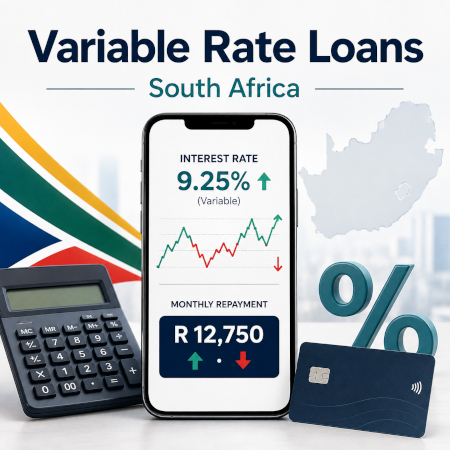 Table of Contents
A variable rate loan can become cheaper when interest rates fall - but it can also cost more when rates rise. For South African borrowers, understanding what moves the rate and how much a change could add to a monthly instalment is important before accepting a loan.
A variable rate loan is a credit agreement where the interest rate can change during the repayment period.
The rate is usually linked to a reference rate specified in the credit agreement. In South Africa, many variable-rate credit products have traditionally been linked to the prime lending rate.
For example, a lender could quote your rate as:
If the reference rate changes, your loan rate changes according to the formula stated in your agreement.
This is different from a fixed-rate loan, where the agreed interest rate remains unchanged for the fixed period.
It is also important not to confuse a personalised rate with a variable rate. A lender may offer you a personalised rate based on your credit profile, but that rate can still be either fixed or variable. What matters is what your quotation and credit agreement say.
For many years, the prime lending rate has been the most familiar reference rate for variable loans in South Africa.
As of August 2026:
The prime lending rate is currently 3.5 percentage points above the SARB policy rate. The Monetary Policy Committee sets the policy rate, while prime has traditionally moved in line with it.
The South African Reserve Bank (SARB) reviews monetary policy regularly. A change in the policy rate can therefore affect prime-linked borrowing costs.
A simplified chain looks like this:
SARB policy rate → prime lending rate → your agreed margin → your loan rate
However, the rate a bank charges an individual borrower is not simply "the SARB rate". Lenders price credit according to factors such as risk, funding costs, the type of credit and the borrower's financial profile.
If a loan is priced at prime + 2% and prime is 10.50%, the loan rate would be:
10.50% + 2% = 12.50% per year
If prime later rises to 11%, the rate would become:
11% + 2% = 13%
If prime falls to 10%, the rate would become:
10% + 2% = 12%
The 2 percentage point margin stays the same unless the agreement allows it to change for another reason.
Some borrowers may receive an offer below prime.
For example:
prime − 0.5%
At a prime rate of 10.50%, this would mean an interest rate of:
10.00% per year
A prime-minus rate does not mean that the loan is risk-free or automatically cheap. The total cost still depends on the loan amount, repayment period, fees, insurance where applicable and future movements in the reference rate.
The effect is easier to understand with an example.
Suppose you borrow R100,000 over 60 months and, for simplicity, there are no additional fees or insurance charges.
Approximate repayments would be:
| Interest rate | Approx. monthly repayment |
|---|---|
| 9.50% | R2,100 |
| 10.50% | R2,149 |
| 11.50% | R2,199 |
| 12.50% | R2,250 |
At 10.50%, the repayment is about R2,149 per month.
If the rate increases by one percentage point, the repayment in this simplified example increases by about R50 per month. A two percentage point increase adds about R100 per month.
That may not sound large on one loan, but the effect becomes more important with:
Actual repayments can differ because lenders may calculate interest and instalments differently, and fees or credit life insurance may form part of the total cost.
If your loan is linked to a variable reference rate and that reference rate falls, the interest rate charged on the loan may also fall according to your agreement.
Depending on the product, this can result in:
The exact effect depends on the loan structure.
A rate reduction does not mean the lender refunds interest already paid. It affects interest charged according to the terms of the agreement from the applicable change date.
The opposite can happen when the reference rate rises.
Your interest rate may increase and the loan may become more expensive.
For a borrower with several variable-rate commitments, such as a home loan and another form of variable credit, higher rates can put noticeable pressure on the household budget.
This is one of the main risks of variable-rate borrowing: you know today's rate, but you cannot know with certainty what the reference rate will be throughout a long repayment period.
Not necessarily on the same day.
The effect depends on:
Your credit agreement should explain how the variable rate is determined.
The National Credit Act also places restrictions on how variable rates may operate. A credit agreement may provide for an interest rate to vary only through a fixed relationship to a reference rate stated in the agreement.
This is why you should check the actual loan agreement rather than assuming that every SARB announcement automatically changes every loan.
Neither type is automatically better or cheaper.
| Feature | Variable rate | Fixed rate |
| Interest rate | Can change | Fixed for the agreed period |
| Future instalments | May change | More predictable |
| Benefit if reference rates fall | Usually yes | Usually no during fixed period |
| Risk if reference rates rise | Yes | Lower during fixed period |
| Budget certainty | Lower | Higher |
| Future interest cost | Less predictable | Easier to estimate |
| Rate structure | Linked to a reference rate | Agreed in advance |
The better option depends on the actual offers available and how much uncertainty you can afford.
A low variable rate today is not automatically better than a slightly higher fixed rate if your budget could not cope with future increases.
Likewise, fixing a rate can mean missing out on lower borrowing costs if market rates fall.
Sometimes. Not always.
There are three basic possibilities.
A variable-rate borrower may benefit because future interest charges can decrease.
The cheaper option will depend mainly on the starting rate, fees, loan term and other costs.
A variable-rate loan may become more expensive, while a borrower with a fixed rate remains protected from those movements for the agreed fixed period.
This is why comparing only today's monthly instalment can be misleading.
Variable rates are more common with some credit products than others.
Variable interest rates are common in South African home finance. A bond may be quoted relative to prime, for example prime minus 0.25% or prime plus 1%.
Because a home loan can run for many years and involve a large outstanding balance, even relatively small rate movements can materially affect repayments.
Depending on the lender and agreement, vehicle finance may be offered on a fixed or variable basis.
Borrowers should check the quotation rather than assume the rate type from the product name.
Personal loans can have different pricing structures.
Some are offered at fixed rates, while particular agreements may provide for a variable rate. For example, Nedbank's loan terms provide for an agreement to be subject to a fixed or variable rate as indicated in the quotation.
If you are comparing offers, see personal loans in South Africa and check the rate type in each lender's actual quotation.
Some revolving credit and other credit facilities can also use variable pricing. Again, the agreement should state the reference rate and the relationship between that benchmark and your actual interest rate.
Prime should not be understood as the interest rate that every customer is entitled to receive.
The rate offered to an individual borrower can depend on factors such as:
Two people applying for similar amounts can therefore receive different rates.
For example:
Borrower A: prime − 0.5%
Borrower B: prime + 3%
If both loans use prime as the reference rate, a movement in prime can affect both loans, but the difference between their agreed margins can remain.
It can affect the rate you are offered, but it does not determine movements in the reference rate.
A stronger credit profile may help a borrower qualify for more favourable pricing, although there is no guarantee that a particular credit score will produce a particular rate.
The lender must also assess whether the credit is affordable. A good credit score does not automatically mean a loan is affordable.
Do not rely only on an advert or product page. Check your quotation and credit agreement.
Look for terms such as:
You should be able to identify:
If these points are not clear, ask the lender to explain them before accepting the credit agreement.
Suppose you receive these two offers:
Offer A: prime + 1%
Offer B: prime + 2%
Offer A appears cheaper, but that alone is not enough to choose between them.
Compare the full quotation, including:
Check both the benchmark and the margin.
A longer term can lower the monthly repayment but may increase the amount of interest paid over time.
It also leaves a variable-rate borrower exposed to interest-rate changes for longer.
Interest is only one part of the cost of credit.
Where applicable, include the premium when assessing how much the loan will actually cost each month.
Look at the total amount repayable under the quotation, not only the amount of cash you receive.
Do not compare the loans only at today's rate. Test how your budget would cope if the rate increased.
A simple way to assess the risk is to calculate how your repayment could change if the interest rate rises.
Ask:
| Scenario | What to check |
| Current rate | Is the repayment comfortable now? |
| Rate +1% | Can you still pay without cutting essential expenses? |
| Rate +2% | Is there still enough money for emergencies? |
| Rate +3% | Would the debt become difficult to manage? |
There is no rule that rates will rise by these amounts. The exercise simply shows how sensitive your budget is to a higher borrowing cost.
If a relatively small increase would make the repayment unaffordable, that is important information before taking on the debt.
A variable rate can have advantages.
If the relevant reference rate falls, the rate on your loan may fall with it.
Depending on the lender and your credit profile, a variable offer may compare favourably with fixed alternatives.
A quotation such as "prime + 1%" clearly shows the relationship between the reference rate and your loan rate.
But these advantages should always be considered together with the risk of rising rates.
A higher reference rate can increase your borrowing cost.
You cannot accurately predict total future interest if you do not know how the reference rate will move.
The longer the loan remains outstanding, the more opportunities there are for interest rates to change.
A borrower who can only just afford today's instalment has less room to absorb a higher repayment.
If several debts respond to the same interest-rate environment, your total monthly debt cost may increase at the same time.
A variable rate may be worth considering when:
It should not be chosen purely because you expect interest rates to fall. Interest-rate forecasts can change.
A fixed rate may be more suitable when predictable repayments are particularly important.
For example, it may appeal to someone who:
The actual fixed-rate offer still needs to be compared with the variable alternative.
Possibly, but it is not an automatic right for every credit product.
Whether you can switch depends on:
For a home loan, for example, some lenders may allow a borrower to request a fixed rate for a particular period. Conditions vary.
Do not assume that you will be able to fix today's variable rate later at the same level.
A variable interest rate does not by itself prevent early settlement.
However, settlement rules and any possible charges depend on the type and size of the credit agreement and the applicable terms under South African credit law.
If you expect to repay the loan early, ask the lender for:
Making additional payments can reduce the outstanding balance and future interest on many loans, but the exact treatment should be confirmed with the lender.
This is particularly relevant in 2026.
The South African Reserve Bank has proposed discontinuing the prime lending rate as a reference rate and replacing it with the SARB policy rate for prime-linked financial contracts.
The proposal is intended to make loan pricing easier to understand. Prime has effectively operated at a fixed spread of 3.5 percentage points above the policy rate since 2001. SARB has said that under the proposed approach, lenders would instead be able to quote their margins directly above the policy rate.
For example, conceptually:
Current structure: prime + 1%
could eventually be expressed relative to the policy rate instead.
This does not mean prime has already disappeared.
As of August 2026, prime is still in use, and the proposed transition is expected only after the cessation of Jibar. The authorities have indicated that the transition would need protections and fallback arrangements for existing contracts.
Borrowers with existing prime-linked loans should therefore continue to follow the terms of their current agreements unless their lender formally communicates a change.
Before signing, check:
You can check and compare legal lenders in South Africa before applying.
A variable rate loan is a credit agreement where the interest rate can change during the loan term according to a reference rate specified in the agreement.
Your lender uses a reference rate and an agreed relationship to that rate. For example, if your agreement says prime + 2%, your interest rate moves when prime changes while the 2 percentage point margin normally remains as specified in the agreement.
A fixed rate stays unchanged for the agreed fixed period. A variable rate can increase or decrease according to the reference rate stated in the credit agreement.
A prime-linked loan uses the prime lending rate as its reference rate. The lender may price the loan at prime, above prime or below prime.
It means your interest rate is two percentage points above prime. If prime is 10.50%, prime + 2% equals 12.50%.
It means your interest rate is one percentage point below prime. At a prime rate of 10.50%, the resulting rate would be 9.50%.
Not on its own. It influences the interest-rate environment and currently determines prime through a fixed 3.5 percentage point spread, but your individual loan rate also depends on the pricing formula in your credit agreement.
It may decrease if your loan has a variable rate linked to a reference rate that falls. The exact impact depends on how your lender recalculates repayments under your agreement.
A variable loan may become more expensive. Depending on the product, your monthly instalment can increase when the reference rate rises.
There is no single frequency that applies to every loan. Changes must follow the reference-rate mechanism set out in the credit agreement. Check the agreement for the relevant calculation and effective dates.
They can be either, depending on the lender and product. Do not assume a personal loan is variable simply because the rate is personalised. Check the quotation to see whether the interest rate is fixed or variable.
Not necessarily. A variable loan may become cheaper if interest rates fall and more expensive if they rise. The starting rate, fees, term and future rate movements all affect the final cost.
Your credit profile can affect the rate and margin a lender offers you. It does not control changes in the underlying reference rate.
Some lenders or products may allow it, while others may require a new agreement or refinancing. Check the lender's terms and the fixed rate available when you want to switch.
Variable-rate credit can generally be settled early, but the settlement process and any applicable costs depend on the credit agreement and relevant National Credit Act rules. Ask the lender for an official settlement amount before paying off the loan.
Check your quotation or credit agreement for wording such as "prime", "prime plus", "prime minus", "variable rate" or "reference rate". If it is unclear, ask the lender to identify the reference rate in writing.
Yes. As of August 2026, the prime lending rate remains 3.5 percentage points above the SARB policy rate. With the policy rate at 7.00%, this gives a prime rate of 10.50%.
A transition has been proposed, but prime has not yet been discontinued. The proposed change would eventually replace prime as a reference rate with the SARB policy rate. The transition is expected to take place only after the Jibar cessation process and requires arrangements for existing contracts.
Interest |
Loan amount |
Term |
NCR Registered |
||
|---|---|---|---|---|---|

|
APR from 29.25%
|
R500 — R8,000
|
from 5 to 35 days
|
Company Reg no.: 2024/739416/07, Credit provider Reg. no.: NCRCP20937
|
|

|
APR up to 60%
|
R500 — R4,000
|
from 5 to 90 days
|
Company Reg no.: 2023/805154/07, Credit provider Reg no.: NCRCP17814
|
|

|
5% per month
|
R500 — R8,000
|
from 1 to 180 days
|
Company Reg. no.: 2025/213906/07, Credit provider Reg. no.: NCRCP22362
|
|