Last updated: 14.07.2026. Author: toprate.co.za
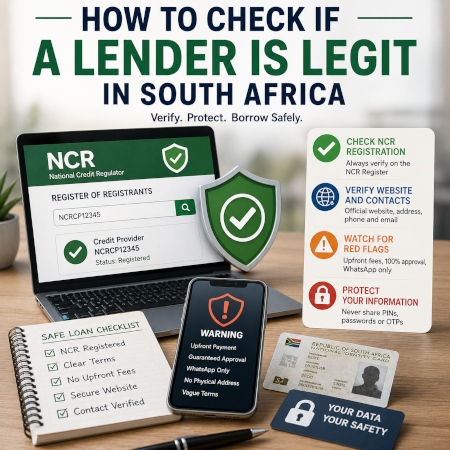 Table of Contents
Before applying for a loan, confirm that the company is registered, the website and contact details are genuine, and the offer clearly shows the full cost of borrowing.
A registration number alone is not enough. Fraudsters can copy the name, logo and NCR number of a real credit provider, so every detail must match before you send an ID copy, bank statements or other personal information.
People searching urgently for credit are common targets for loan scams in South Africa. Fraudsters know that applicants with an emergency, previous decline or poor credit history may be more willing to act quickly.
A typical scam begins with an unsolicited offer received through:
The message may claim that you have already been approved, even though you never completed a proper affordability assessment. The fraudster then requests money for supposed insurance, VAT, legal costs, loan clearance or the release of funds.
The National Credit Regulator has warned that advance-fee scammers often promise to release a loan after an upfront payment. Once the first payment is made, the fraudster may disappear or demand additional payments.
Other fake loan companies are interested primarily in personal information. An ID copy, payslip, proof of address and bank statement can potentially be used for impersonation, fraudulent applications or further targeted scams.
Checking a lender before submitting documents reduces the risk of:
Do not assume an offer is safe because it contains an official-looking logo, company registration number or professional document. These details can be copied from a legitimate business.
The most important first step is to check the National Credit Regulator’s official Register of Registrants.
The NCR is responsible for registering credit providers, credit bureaus and debt counsellors and enforcing compliance with the National Credit Act. South Africa’s registration threshold for credit providers was reduced to zero, meaning businesses providing regulated credit generally need NCR registration rather than being exempt because their loan book is small.
A registered credit provider normally displays a registration number beginning with NCRCP, for example:
NCRCP0000
The number may appear:
The absence of a visible NCRCP number is a warning sign, but finding a number does not complete the verification.
Search the NCR Register of Registrants using:
The register can show information such as the provider’s:
The NCR register separates currently registered providers from registrations that have lapsed, been voluntarily cancelled or been cancelled by the National Consumer Tribunal. Make sure the lender appears in the current Registered section rather than relying on an old or inactive registration.
Compare the official record with the company contacting you.
Check whether the following details are consistent:
| Detail | What to compare |
|---|---|
| Legal company name | NCR register, agreement and website |
| Trading name | Website and marketing materials |
| NCRCP number | Official NCR record |
| Company registration number | Terms, agreement and official record |
| Phone number | NCR record and official website |
| Physical address | Register, website and agreement |
| Email domain | Should correspond with the official company |
| Website address | Should be the company’s genuine domain |
| Bank beneficiary | Should match the verified business |
A mismatch does not always prove fraud because legitimate companies can change offices or contact details. However, do not proceed until the difference has been explained and independently confirmed.
When an offer claims to come from a known company, do not use the contact information inside the message.
Instead:
This step is important because scammers can impersonate an NCR registered lender and use the genuine provider’s registration information. NCR warnings have specifically noted cases in which criminals copied the registration details of lawful credit providers.
A professional-looking website is not proof that a lender is legitimate. Scam websites can copy text, logos, reviews and legal details from real companies.
Use the following checks before completing an online form.
Look carefully at the website address.
Common impersonation tactics include:
For example, a scammer may replace a letter with a visually similar character or use a domain that is only one character different from the genuine lender’s address.
Search for the company independently and compare the domain with:
Do not assume that the first sponsored search result belongs to the real lender.
A legitimate credit provider in South Africa should be identifiable as a legal business.
The website should provide sufficient details to establish who operates it, such as:
A map pin, virtual office or copied address does not prove legitimacy. Compare the address with the NCR register and other official company information.
Call the customer-service number before sending documents.
Be cautious when:
A mobile number is not automatically fraudulent, but a lender that can only be contacted through one unverified mobile number requires additional checks.
A business email address should normally use the lender’s official domain, such as: support@companyname.co.za
An address using Gmail, Outlook or another free email service is not conclusive proof of fraud, particularly for a small business. However, it should not be accepted as sufficient evidence that the sender represents a registered lender.
Check for:
A lender collecting IDs, bank statements, payslips and contact information should explain:
A vague statement such as “we protect your data” is not a complete privacy notice.
Also determine whether the website is a direct lender or a lead-generation service. Some sites collect an application and distribute it to several partner lenders. This is not necessarily fraudulent, but the applicant should be told who receives the information.
The website should explain:
Copied terms containing a different company name, foreign laws or references to another country are strong warning signs.
A loan application page should use an encrypted connection. The address should normally begin with: https://
Your browser should not display a security or certificate warning.
HTTPS helps protect information while it is transmitted, but it does not prove that the company is legitimate. Scammers can also obtain security certificates for fake websites.
Treat HTTPS as a minimum technical requirement, not proof that you have found one of the legit lenders in South Africa.
One warning sign may have an innocent explanation. Several warning signs together are a strong reason to stop the application.
An upfront fee loan scam usually involves a request for payment described as:
The fraudster promises that the loan will be transferred immediately after payment. Once the money is sent, another reason may be invented for requesting more.
This must be distinguished from a legitimate initiation fee. The National Credit Act permits regulated initiation fees as part of the cost of credit, and consumers may be given the option to pay an initiation fee separately rather than finance it. However, a legitimate fee must be disclosed in the formal quotation and credit agreement and must comply with applicable limits. It should not appear as an unexpected payment to an individual or unrelated account to “unlock” an approved loan.
Stop when:
Legitimate lenders assess whether the applicant qualifies and can afford the repayments.
A claim of guaranteed approval is especially suspicious when the lender says it does not need to check:
The National Credit Act requires responsible credit assessment and prohibits reckless lending. A genuine provider cannot know that every applicant will be approved before reviewing their circumstances.
WhatsApp itself is not unsafe. Some registered lenders use it as an official service channel.
The risk is higher when the supposed lender:
Verify the WhatsApp number through the lender’s official website before sharing anything.
A scam or unlawful lender may focus only on the amount available and avoid explaining:
Do not accept screenshots or chat messages as a substitute for a formal quotation and agreement.
A legitimate lender may need your bank account number and bank statements. It should not require your:
Do not approve a banking notification unless you understand exactly what transaction or mandate it authorises.
Fake lenders may copy:
Some create email addresses or domains that differ only slightly from the real lender’s details.
Always verify an unexpected offer directly with the genuine company.
Pressure tactics may include claims such as:
A legitimate loan application should give you time to read the quotation and agreement. The National Credit Act requires a pre-agreement statement and quotation before a regulated credit agreement is concluded.
Unsolicited loan messages should be treated as unverified until independently confirmed.
A link can lead to:
Do not open attachments or install an app sent by an unknown loan agent.
Open a new browser window and search for:
Do not rely on the contact details provided by the person being checked.
Confirm that the number appears on:
A WhatsApp business badge or logo is not enough.
Call the lender’s published switchboard and ask whether:
Do not let the original agent transfer your call to a supposed verification department. Start the verification independently.
Documents that require protection include:
A fraudster may use these documents to make later scams more convincing or attempt impersonation fraud.
A fake Facebook or Instagram page may use a known lender’s name and logo.
Check:
A large follower count is not proof of legitimacy.
A genuine offer should provide enough information to understand both the benefit and the obligation.
The documents should distinguish between:
Do not assume that the advertised amount is the net amount you will receive.
The offer should state:
The quotation should state the applicable interest rate and how it affects the cost of the loan.
Do not accept statements such as “low interest” or “affordable rate” without actual figures.
The offer should identify relevant charges, which may include:
Fees must be disclosed rather than introduced after you accept the offer.
The repayment schedule should show:
If the loan uses a debit order or DebiCheck mandate, confirm that the creditor, amount and collection date match the agreement.
Do not compare loans using only the monthly instalment.
Review:
A smaller instalment can result from a longer term and may produce a higher overall cost.
The quotation and agreement should identify the legal credit provider, including relevant registration and contact details.
Be careful when the website uses one brand but the agreement unexpectedly names an unrelated company. There may be a legitimate lending partner, but that relationship should be clearly explained.
The National Credit Act requires a credit provider to give the consumer a prescribed pre-agreement statement and quotation before concluding a regulated credit agreement. These documents allow the applicant to review the proposed costs and terms before signing.
Do not sign:
Act before the fraudster can obtain more money or information.
Stop communicating about payment, even when the sender threatens to cancel the loan or report you.
Do not send a second payment in an attempt to recover the first. Advance-fee scammers often invent additional charges after the victim has already paid.
Stop providing:
Do not follow instructions to delete the conversation.
Save:
This information may help your bank, the impersonated lender, the platform or authorities investigate.
When money was transferred or banking information was disclosed:
Speed matters when a payment has already been made.
When the scam used a genuine company’s name, notify that company through its official fraud or customer-care department.
The lender may already know about the impersonation and can confirm whether the offer is false.
Suspected unregistered lending, misuse of an NCR registration or problems involving regulated credit can be reported to the National Credit Regulator.
The NCR handles consumer assistance, complaints and investigations and publishes a register of authorised credit providers.
Depending on what happened, report it to:
Yima allows consumers to report suspected scams and operates a South African scam hotline.
If ID documents or extensive personal information were exposed, consider SAFPS Protective Registration. The free service alerts participating organisations to take additional precautions when dealing with your identity details.
If fraudulent accounts have already been opened, contact the affected credit providers and credit bureaus. A fraud dispute may require supporting documents such as an affidavit and FICA documents.
Review your credit reports for:
Continue checking after the incident because an attempted fraudulent application may not appear immediately. Credit monitoring alerts can also help identify suspicious enquiries or new accounts.
Find the lender’s NCRCP number and search for it in the National Credit Regulator’s official Register of Registrants.
Confirm that the record shows the provider as currently registered and that the legal name, trading name, address and contact information match the company you are dealing with.
Do not rely only on a registration certificate or number sent by the loan agent.
A loan application is not automatically fraudulent because WhatsApp is used. Some registered lenders operate verified WhatsApp support channels.
It becomes risky when the agent contacts you unexpectedly, cannot be verified through the official lender website, asks for an upfront payment or requests sensitive documents before providing formal terms.
Verify the number independently before continuing.
A regulated initiation fee can lawfully form part of the cost of credit and should be clearly disclosed in the quotation and agreement. Consumers may in some cases be offered the option of paying it separately rather than adding it to the loan balance.
This is different from an unexplained payment demanded by an agent to release, insure, clear or activate an already “approved” loan. A payment to a private or unrelated account before payout is a major scam warning.
Yes. Fraudsters can copy a genuine lender’s:
Confirm the offer by contacting the real company through independently obtained contact details.
A scammer can display a genuine registration number belonging to another business.
Search the number in the official NCR register and compare all details. Registration confirms that the named business is registered; it does not prove that the person messaging you represents that business.
No. HTTPS means that information sent between your browser and the website is encrypted.
It does not confirm that the business is genuine, registered or trustworthy. Fake websites can also use HTTPS certificates.
A legitimate lender cannot guarantee approval for every applicant before assessing identity, income, expenses, existing debts and affordability.
Claims of 100% approval, particularly when combined with an upfront payment or no financial assessment, should be treated as a serious warning sign.
Depending on the product, a lender may request:
The request should come through a verified and secure channel after you have confirmed the lender’s identity and understood how the information will be used.
No legitimate lender needs your card PIN or online banking password.
Never disclose an OTP unless you understand the exact transaction or mandate being authorised. Do not give a loan agent remote access to your cellphone or computer.
Do not call the number included in the suspicious message.
Use the telephone number published on the bank’s official website, banking app, bank card or previous verified correspondence. Ask whether the application reference, sender and offer are genuine.
Stop communication and do not send more information.
Notify your bank when banking details were included, preserve all evidence, report the incident and contact SAFPS about identity-protection options. Check your credit reports and monitor them for unfamiliar enquiries or accounts.
When fraudulent credit appears, contact the relevant credit provider and credit bureau and prepare supporting documentation such as an affidavit.
Contact your bank or payment provider immediately and explain that the transfer may be fraudulent.
Save all messages, beneficiary information and payment confirmations. Report the matter to the relevant platform, Yima, the genuine company being impersonated and SAPS where appropriate.
Do not pay another fee, even when the agent promises that it will recover the first payment.
Website testimonials can be selected, edited or fabricated.
Check independent sources, but remember that external review sites can also contain manipulated feedback. Reviews should support, not replace, NCR registration and company verification.
Safe online loans are available from properly registered and verified providers, but the application channel does not make a loan safe by itself.
Confirm the lender, use the genuine website, read the quotation, compare the total repayment and never share security credentials.
Do not continue until the company explains why and you independently confirm its legal status.
A person providing regulated consumer credit in South Africa will generally need to be registered. Do not send documents or money to a business that claims registration is unnecessary merely because it operates online or offers small loans.
Yes. A comparison platform or broker may collect an application and refer it to a separate registered credit provider.
The website should clearly explain that it is an intermediary, identify how personal information is shared and disclose which company is issuing the credit agreement. Verify the actual lender named in the quotation.
Start with the NCR Register of Registrants, then compare each provider’s legal name, registration status, website, address and contact information.
Registration does not mean that a loan is affordable or suitable. You must still compare interest, fees, repayment term and total cost.
A lender may send a conditional or marketing offer based on limited information, but final approval should still depend on verification and assessment.
An unsolicited message saying that funds are already approved and only require an upfront payment is a common sign of a loan scam.
Report the incident to the payment provider or bank, the platform where the message appeared, the genuine company being impersonated and relevant authorities.
Yima accepts South African scam reports, while the NCR handles complaints and investigations involving credit providers and National Credit Act compliance. Serious fraud or identity theft should also be reported to SAPS.
Interest |
Loan amount |
Term |
NCR Registered |
||
|---|---|---|---|---|---|

|
APR from 29.25%
|
R500 — R8,000
|
from 5 to 35 days
|
Company Reg no.: 2024/739416/07, Credit provider Reg. no.: NCRCP20937
|
|

|
APR up to 60%
|
R500 — R4,000
|
from 5 to 90 days
|
Company Reg no.: 2023/805154/07, Credit provider Reg no.: NCRCP17814
|
|

|
5% per month
|
R500 — R8,000
|
from 1 to 180 days
|
Company Reg. no.: 2025/213906/07, Credit provider Reg. no.: NCRCP22362
|
|